I get asked this more than almost anything else, usually by someone standing in a riad courtyard in Marrakech, phone out, three tabs open, looking slightly desperate for permission.
So let me save you the agonising.
Yes. Essaouira is worth it. It's one of my favourite places in the whole country and I will defend it against anyone.
But — and this is the part the tour listings won't tell you — the day trip version is a bit silly, and you should probably stay the night instead.
Let me explain, and then let me tell you how to do it properly if one night genuinely isn't possible.
The maths problem
Essaouira is about 190 km west of Marrakech. That's two and a half to three hours by road, each way.
So a day trip looks like this: roughly six hours in a vehicle in exchange for four, maybe five hours in the town. And that's on a good day, with no traffic leaving Marrakech, which is not a thing I would personally bet money on.
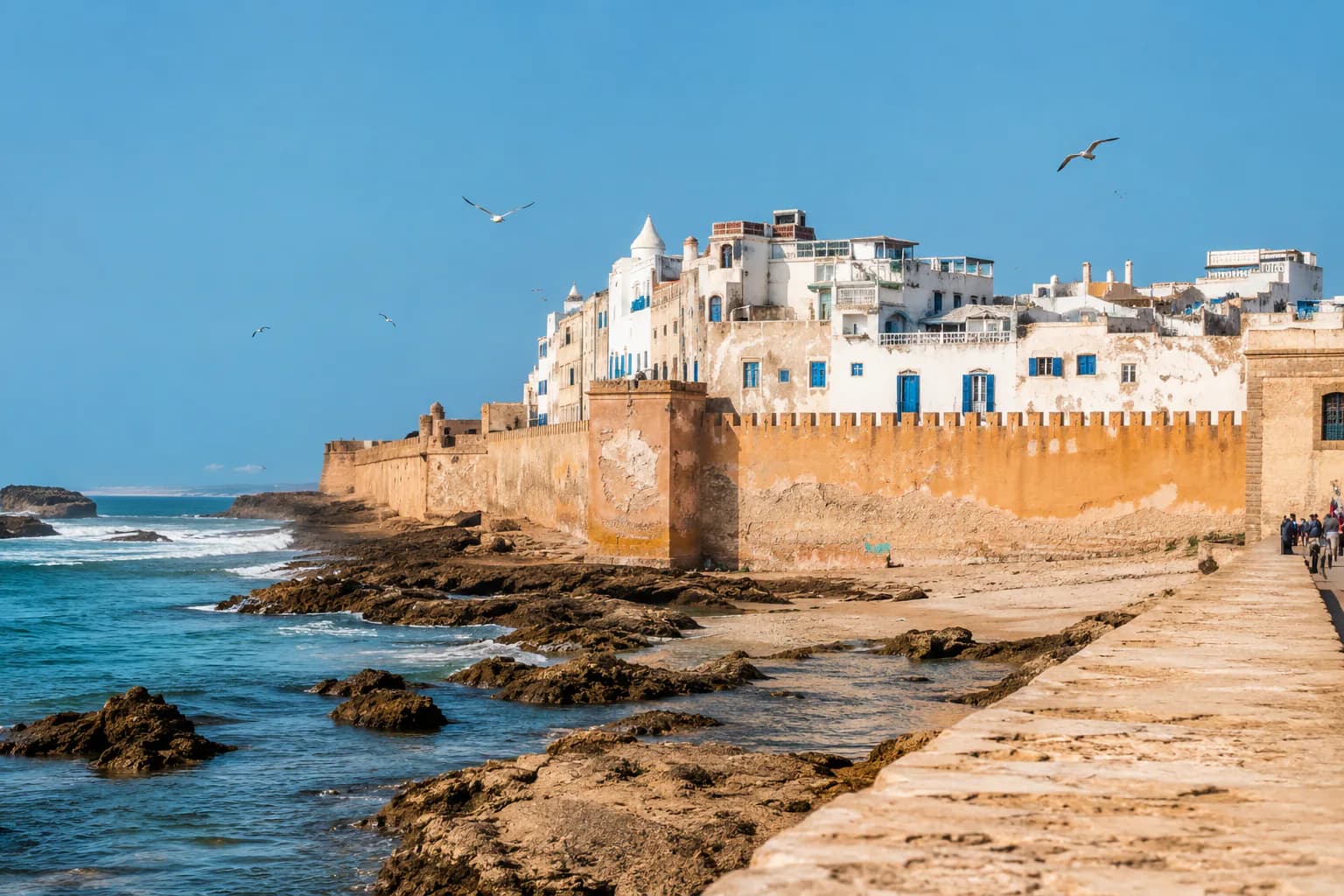
Five hours is enough to walk the ramparts, eat some fish, wander the souks and take the photo of the blue boats. It is not enough to sit on a terrace at seven in the evening with the wind dropping and the light going gold, which is when Essaouira stops being a nice medina and becomes a place you start looking up property prices in.
One local guide puts it perfectly: Game of Thrones brought a lot of people who come, take a photo of the ramparts and leave the same day. If that's you, you're missing most of it.
Harsh. Also true.
My actual recommendation: take an early bus one morning, stay one night, come back late the next day. Two nights if you have them. You'll spend less time in transit than most day-trippers and you'll see a completely different town after dark.
But if your itinerary is locked and one day is all you've got — fine. Here's how to not waste it.
Getting there: don't book a "tour"
This is the bit where I save you money.
The organised day tours are mostly just a minibus. You'll pay a premium for hotel pickup, a driver, a stop at an argan cooperative, and then be released into Essaouira for four hours anyway, with a meeting time hanging over you like homework.
The bus is better. Cheaper, more comfortable than you'd expect, and it drops you closer.
Option: Supratours bus — 100–140 MAD each way. 6–7 daily, from around 7:45am. Drops you at Bab Marrakech, under 50 m from the medina. My pick.
Option: CTM bus — ~105 MAD each way. One departure, 8:30am, returning around 5pm. Reliable, but the Essaouira station is 1.5 km out.
Option: Organised day tour — from ~$18 up to $150+. Cheap ones are transport only. Expensive ones are private with a guide.
Option: Private car / taxi — negotiate, agree first. Best if there are four of you and you want to stop on the way.
Two practical notes on the buses. Neither leaves from the main Gare Routière — both stations sit near the Marrakech train station, a few blocks apart. And Supratours charges a few dirhams extra per suitcase for the hold, which catches people out at the counter.
Take the 7:45am. I mean it. Every hour you shave off the front of the day is an hour you get in Essaouira, and the last bus back leaves around 5:30pm.
What Essaouira actually is
Here's what I love about it, and it's not the thing people expect.
Essaouira is a designed city. The 18th-century fortified medina — UNESCO World Heritage since 2001 — was laid out by a European engineer for a Moroccan sultan, which is why it feels so unlike Marrakech. The streets run straight. There's a logic to it. The medina is roughly a rectangle and you genuinely cannot get properly lost, which after three days in the Marrakech medina — the kind of place explored on a Marrakech Medina, Souks & Stories experience — feels like someone has turned the difficulty setting down.
It's also windy. Relentlessly, gloriously windy. They call it the Wind City of Africa, the Atlantic trade winds keep summers around 10°C cooler than Marrakech, and the bay is one of the best places in Africa to learn to surf or kitesurf. Lessons start from about $25.
Bring a jacket. I don't care what month it is. Bring a jacket.
How I'd spend five hours
Time: ~11:00 — What: Arrive, walk straight through Bab Marrakech into the medina
Time: 11:15 — What: Skala de la Ville — the sea ramparts, Portuguese brass cannons, about 20 MAD
Time: 12:00 — What: Wander the souks off Avenue de l'Istiqlal. Thuya wood is the local speciality
Time: 13:00 — What: The port and the fish market
Time: 14:30 — What: Walk the beach, or a mint tea somewhere with a view
Time: 15:30 — What: The Mellah, if you want the quieter, sadder, more interesting version of the town
Time: 16:45 — What: Back to the bus, wind-blown and salty
The fish is the whole point. Go to the port in the early afternoon. Hundreds of blue wooden boats — real working ones, not props for tourists — with the day's catch coming in, an auction going on, seagulls making a scene, and cats conducting themselves with enormous confidence.
Then do the thing: buy fish at the market and take it to one of the nearby grills, who'll cook it for you for a small fee. Sardines straight off the boat, grilled over charcoal, eaten with your fingers and too much salt. That is the single best meal in this article and it costs almost nothing.
The film stuff, since someone will ask. The ramparts played Astapor in season three of Game of Thrones. Orson Welles shot Othello here in 1949 and there's a Place Orson Welles by the sea walls to prove it. It also stood in for Jerusalem in Kingdom of Heaven and turns up in John Wick: Chapter 3. Jimi Hendrix visited in 1969, and roughly nine hundred shopkeepers will tell you he stayed in their building.
The Mellah is the part almost no day-tripper reaches, and it's the part that stays with me. In the late 1800s Essaouira was around 40% Jewish, one of very few places where the two communities lived so closely and so peacefully. Many houses still have a Star of David carved above the door. Much of the quarter fell into ruin after the community emigrated in the fifties and sixties. Restoration work is underway now. Walk it slowly.
Two honest warnings
The argan stops. Every organised tour breaks at an argan cooperative on the Marrakech road. Some are genuine women's cooperatives doing real work. Some are gift shops that have learned the word "cooperative." And the goats standing in the argan trees, which are famously photogenic — a number of them are put there. They do climb naturally. Not always on that schedule, for that long, right beside a lay-by.
June is the Gnaoua World Music Festival, which is magnificent and also means the town is completely full. Either plan around it or plan for it. Don't discover it on arrival.
Best months overall: April to June, or September to October. Moderate wind, decent sun, thinner crowds.
So — worth it?
Worth going to Essaouira: absolutely, without hesitation, one of the great small cities of Morocco.
Worth doing it as a day trip: only if the alternative is not going at all. Six hours of driving for five hours of town is a poor exchange rate, and you'll spend the last hour of it watching the clock instead of the sea.
Take the early bus. Stay one night. Eat the sardines, walk the ramparts at sunset, and let the wind absolutely ruin your hair.
Then come back and tell me I was right.