The Palmeraie is the most misunderstood place in Marrakech, and it's mostly the photographs' fault.
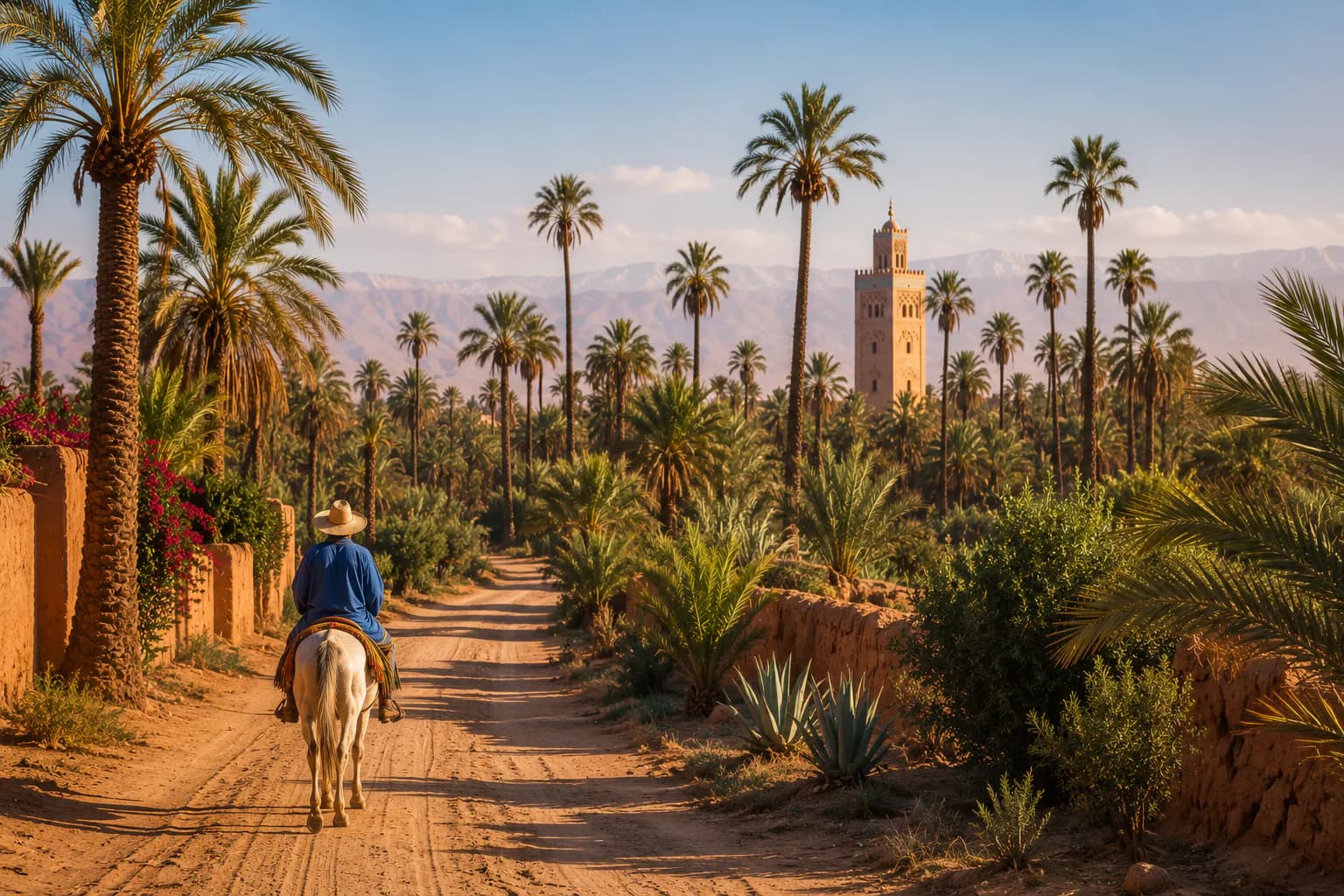
You've seen them: endless date palms, a camel silhouette, golden light, not a building in sight. Then you arrive and find a dual carriageway, a golf course, some half-built villas, a fair amount of dust, and palms that look like they've had a difficult decade.
So let's answer the question honestly: the Palmeraie is not a sight. It's a place. Nobody should go there to look at it. Plenty of people should go there to do something in it. Those are very different trips, and confusing them is why half the reviews are furious.
The world's most successful piece of littering

The origin story is excellent. In the 11th century, around 1070, Sultan Youssef ben Tachfine of the Almoravid dynasty — the man who made Marrakech the capital — camped his soldiers on the plain north of the new city. They ate dates and chucked the pits on the ground. Palms grew. A thousand years later, there's an oasis.
It's a great story and it is, sadly, mostly a story. The real version is better engineering and less romantic: the Almoravids built a network of khettaras, underground canals that tap groundwater from higher ground and walk it downhill to the roots by gravity alone. No pumps, no power, just very good maths. The technique goes back to at least the first millennium BC, and an estimated 5,000 access wells were sunk across the plain.
That's the thing worth understanding before you visit. The Palmeraie was never a natural oasis. It's a thousand-year-old piece of hydraulic infrastructure that happens to look like scenery, planted to feed a brand new capital city.
At its height it covered around 14,000 hectares and supported something like 100,000 palms, plus olives, orchards and market gardens in their shade — along with roughly 50 bird species and 20 kinds of reptile.
The uncomfortable part
Here's what the tour listings don't mention.
The Palmeraie is in serious trouble. Its area has roughly halved from that historic peak, with about 30% lost in the last twenty years alone. The farmers left for more lucrative work, big modern farms out in the Haouz plain took over food production, and the khettaras — with nobody left to maintain them — were abandoned.
Then came the pumps. Palm roots can reach about 15 metres down to find water. The water table has dropped by more than 40 metres. You can see the arithmetic problem.
A royal decree from 1929 theoretically protects the grove, and 1920s planning rules famously banned any building taller than a palm tree. In practice, development has proceeded on a long series of exceptions, and the villas, resorts and irrigated golf greens now drawing that same shrinking groundwater are the reason the whole thing is called, without much irony, a green lung.
None of this means don't go. It means go with your eyes open. You're visiting a working landscape under real strain, not a postcard — and honestly, that's a more interesting thing to look at.
What there actually is to do

Access to the Palmeraie is free. There's no gate and no ticket. It begins about 7 km northeast of the medina, and a taxi from Jemaa el-Fnaa runs 50–80 MAD one way. Agree the fare first, as ever.
Activity — Rough 2026 price — Time
Camel ride through the groves — 200–400 MAD / €20–40 — ~1 hr
Quad biking — from 350 MAD / €35 — 1–2 hrs
Combined quad + camel tour — ~€40–60 — ~2 hrs
Horse riding — varies by stable — 1–2 hrs
Hot air balloon (launches here) — €150–170 — Half morning
Resort day pass (pool, spa, lunch) — varies widely — Full day
Cycling the Circuit de la Palmeraie — free, plus bike hire — Half day
Most excursions include hotel pickup and drop-off, and 2–3 hours covers the whole thing door to door.
The camel ride is the classic, and it's a gentler proposition than the desert version — an hour's plod through the palms and past small villages, usually ending with mint tea at a family house. It's pleasant, photogenic and genuinely relaxing. It is not a Saharan expedition, and anyone selling it as one is having you on.
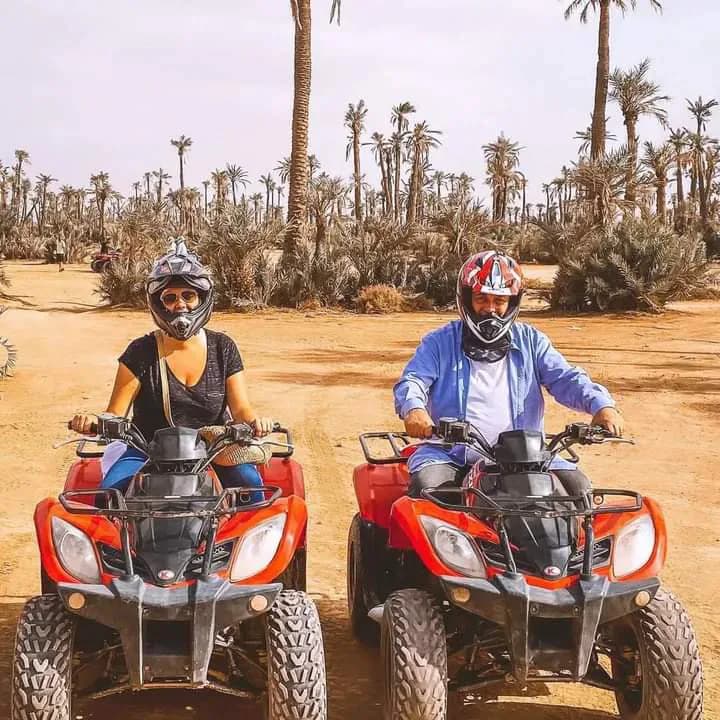
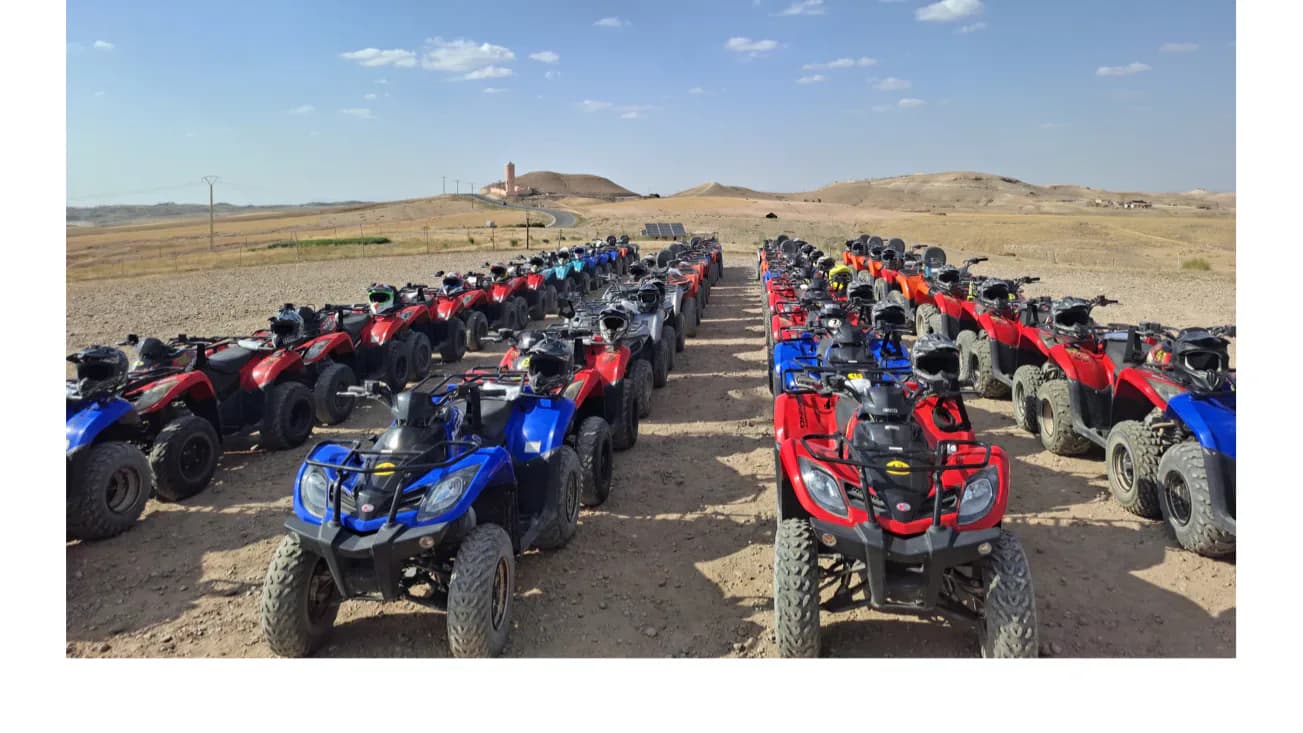
The quad tour is dustier and more fun, running tracks through the grove and out toward the rocky Jbilet hills. Long trousers, closed shoes, and a scarf over your face. The scarf is not for style. For a bookable version of this sort of outing, Ajili’s “Quad & Buggy Adventure Through Morocco’s Palm Groves” follows palm-grove trails and open Moroccan landscapes.
The resort day pass is the Palmeraie's most underrated move. Several of Marrakech's best hotels are out here — Four Seasons, Amanjena, Nikki Beach among them — and many sell day access to the pool, spa and restaurant. After three days of medina heat and haggling, spending one afternoon horizontal beside a pool with a book is not a failure of ambition. It's excellent trip management.
The Circuit de la Palmeraie is a 22 km loop road winding through the grove past hotels, gardens and farmland. It's popular with cyclists and makes a good half day by bike, car or taxi. It also shows you both Palmeraies within a few minutes of each other — ancient palms and Berber smallholdings on one side, gated villa compounds on the other. That contrast is the real story of the place, and driving the loop is the fastest way to understand it.
Practical bits
Go early or late. Before 10am or after 4pm. There's very little shade, and midday in summer regularly clears 40°C. Sunset is when the palm silhouettes earn their reputation.
Bring water. Outside the resort areas there are very few places to buy anything.
Wear sensible shoes. Especially for quads or camels. Sandals will end in regret.
Bring cash. Small notes for tips, tea and the guides.
Don't rent a car just for this. Driving inside the grove is limited to established tracks and access roads anyway, and every operator collects you from your riad.
So, is it worth visiting?
Go if… — Skip it if…
You want a camel ride, quad tour or balloon flight without leaving the city — You're picturing an untouched desert oasis
You're staying at a Palmeraie hotel anyway — You've only got three days and haven't seen the medina properly
You fancy a pool-and-spa day pass to reset mid-trip — You're heading to Agafay or Merzouga later — those are the same activities in better scenery
You like landscapes with a story, including a complicated one — You need a clear "attraction" with a gate and a ticket
You want a 22 km bike loop and a look at how the other half lives — You're expecting shade. There is barely any shade
The short version: the Palmeraie is worth an afternoon, not a pilgrimage. If you're doing a desert trip later in your itinerary, skip the camel here and save it for the sand. If you're not, this is a perfectly lovely, low-effort hour on a camel twenty minutes from your riad.
And if you're staying out here, or you've got one afternoon left and no energy for another palace, take the day pass. Sit by the pool. Look at the palms — the surviving ones, planted by a sultan's soldiers a thousand years ago and watered by canals dug by hand.
They're still standing. Mostly. Which is more than you'll manage after four days in the medina.