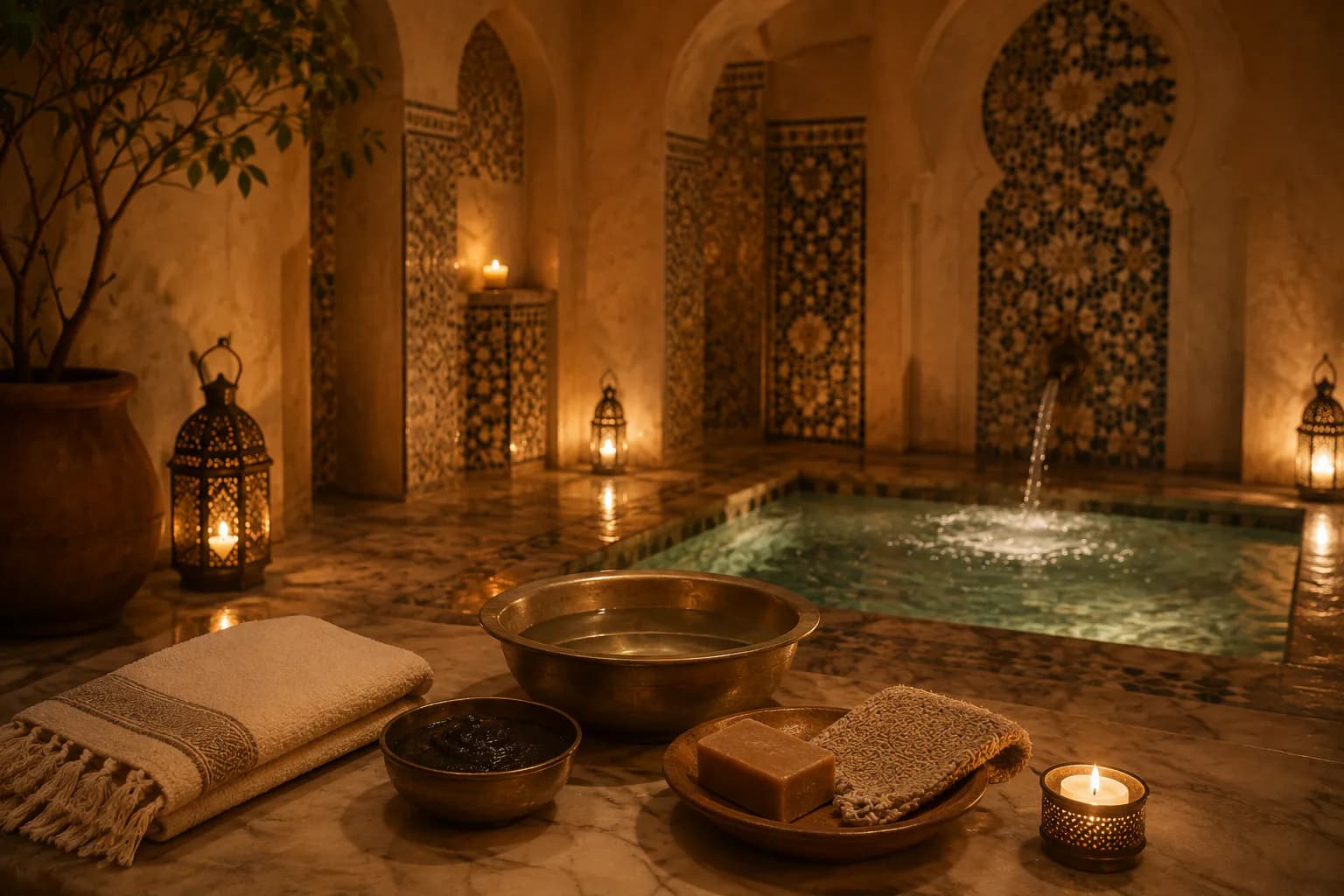
My grandmother took me to our neighbourhood hammam every Friday until I was about eleven, and I complained the entire way there every single week. Too hot. Too loud. Too much scrubbing. Then we'd walk home in the cool air with my hair wrapped in a towel, feeling like a brand new person, and I'd forget I'd ever objected.
I still go. And every time a friend visits Morocco and asks me what one thing they should do, I say: the hammam. Not the camel. Not the palace. The hammam.
But I've also watched enough visitors walk in with completely the wrong idea to know this needs explaining first. So let me tell you exactly what's going to happen to you, because nobody enjoys a surprise involving a stranger and an abrasive glove.
First, forget the word "spa"
A hammam is not a spa. A spa is a treat. A hammam is maintenance.
For most Moroccan families it's a weekly institution, somewhere between a bath, a social club and a small community meeting. My grandmother caught up on every piece of news in the neighbourhood in that steam room. Deals were made. Marriages were quietly discussed. It's warm, it's loud, and it is not remotely serene.
Historically, every quarter of the medina was built around five things: a mosque, a bread oven, a fountain, a shop, and a hammam. That's how essential it was. It's not decoration for tourists. It's plumbing, in the nicest possible sense.
Knowing that changes how you walk in. You're not buying a treatment. You're joining something.
Three kinds of hammam, and which one I'd send you to
The neighbourhood hammam (hammam de quartier) is the real thing. Entry is about 10–25 MAD, and if you want an attendant to scrub you it's roughly another 50–100 MAD. You bring your own kit, you sit on hot tiles with local women or men, you wash yourself, and nobody is playing spa music because nobody has ever thought of it. It's the most authentic version and by far the cheapest.
It's also, I'll be honest, a lot for a first visit. There's no reception desk, limited English, and no one is going to explain the sequence to you. If you're the sort of traveller who enjoys being slightly out of your depth, go. You'll love it. If you're not, don't force it.
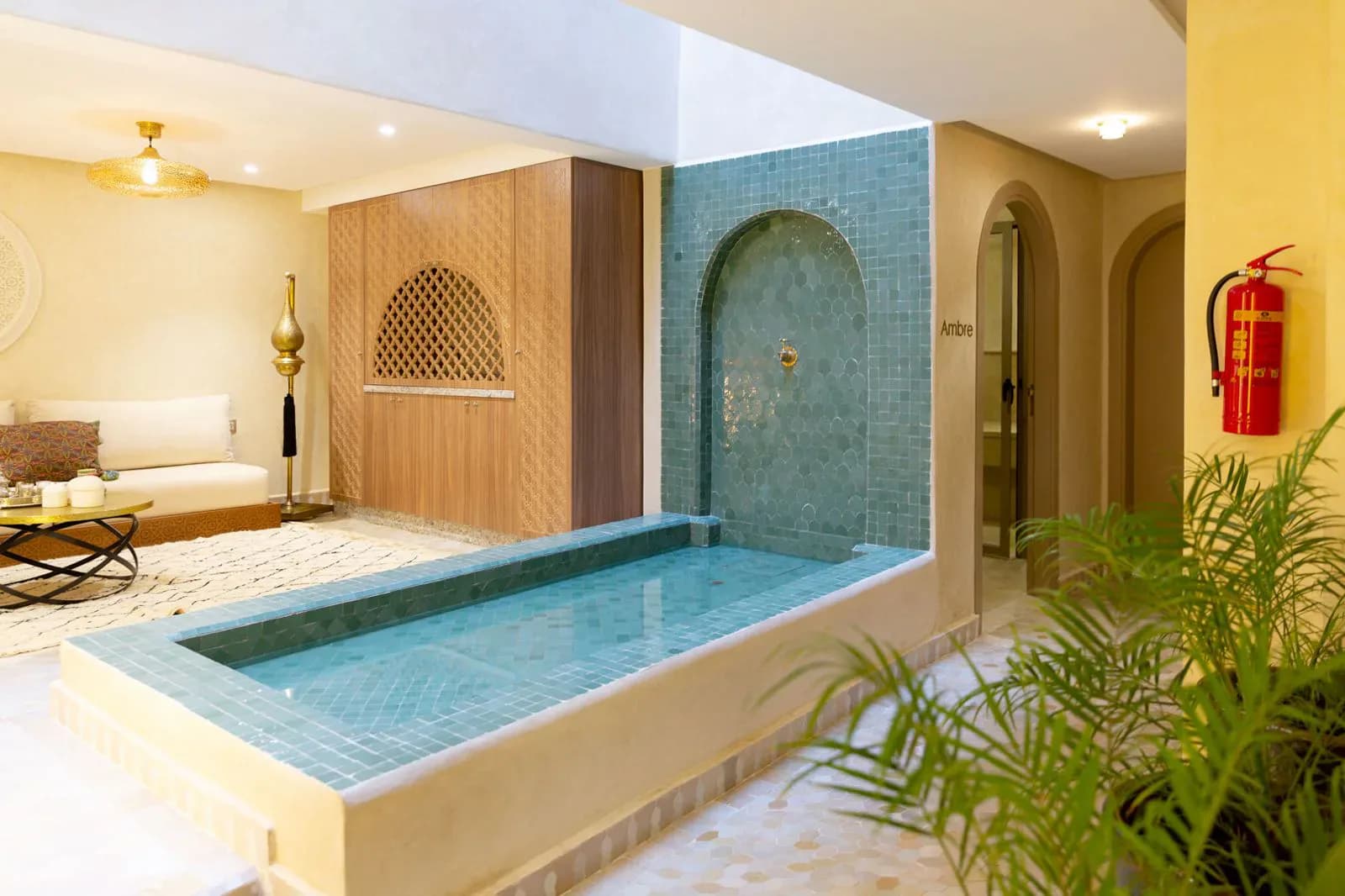
The riad or boutique hammam is what I recommend to almost every first-timer. Around 300–700 MAD depending on the package. Same ritual, same black soap, same terrifying glove — but in a private room, with staff who speak French or English and will walk you through each stage. You get the experience without the anxiety of not knowing what's happening next. For a bookable option, try Ajili's Traditional Moroccan Hammam & Massage Experience.
The luxury hotel spa runs 1,000–1,600 MAD and up. Beautiful. Faultless. Slightly further from the point, but if you want a marble palace and an argan oil massage afterwards, nobody's stopping you.
Here's my honest advice: do the riad hammam in your first few days. If you love it — and you probably will — find a neighbourhood one before you leave. The second visit is when it stops being an experience and starts being a bath.
What actually happens
The whole thing takes about ninety minutes to two hours. The order barely changes anywhere in Morocco, because it's not a spa menu, it's a sequence that makes physical sense.
You get warm. You're given a towel and sandals, you change, and you go into the warm room to sit on heated tile while water is poured over you. Nothing is happening yet. This is on purpose. Your skin needs to soften.
Then the hot room. Around 40–45°C with heavy humidity. Your muscles let go whether you'd planned to relax or not.
Black soap goes on. Savon beldi is a dark, thick, olive-based paste that smells earthy and slightly agricultural, and it's left on your skin for five to ten minutes. It doesn't lather. It's not meant to. It's softening everything for what comes next.
Then the scrub. This is the part nobody warns you about properly, so I will.
The attendant — the kessala — puts on a coarse mitt called a kessa and scrubs you in long, firm strokes. Arms, legs, back, stomach, neck. All of it. It is vigorous. It is not gentle. And grey rolls of dead skin will visibly come off you in quantities that feel genuinely insulting given you showered this morning.
This is normal. It is supposed to happen. Everyone's does it. Try not to be embarrassed, because your kessala has seen roughly four thousand people react exactly the way you're about to.
If it's genuinely too hard, say shwiya — "a little." They'll ease off. Nobody wants to hurt you.
Buckets of water. Cool, then warm, tipped over you without ceremony. The temperature contrast is the point. This is when your skin starts feeling like something that belongs to someone much younger.
Then, often, ghassoul clay. A mineral clay mask left to dry slightly before rinsing. Sometimes a rhassoul hair treatment too.
And mint tea at the end. Always. You'll sit somewhere quiet, slightly stunned, drinking tea and feeling like your bones have been replaced.
The question everyone's too shy to ask
What do you wear?
Keep your underwear on. That's the simple answer and it covers you everywhere. In women's hammams, going topless is completely normal and nobody will glance at you twice, but you're under zero obligation. In men's hammams, underwear stays on, always, no exceptions. Some places give you a loincloth; a swimsuit is fine too.
Nobody is looking at you. Genuinely. Everyone is far too occupied with their own dead skin.
What to bring
For a riad or hotel hammam, nothing. It's all provided.
For a neighbourhood hammam: a towel, flip-flops (the floors are wet and very hot), a change of underwear for afterwards, shampoo, savon beldi and a kessa glove. You can buy the soap and glove at the entrance or in any souk for about 20–30 MAD, and honestly the kessa makes a much better souvenir than a lamp. A small plastic bucket helps, and can also be bought there.
Small things that make you look like you've done this before

Greet people when you come in. A salam goes a long way in a room where everyone knows each other.
Rinse your spot when you leave it. This is basic courtesy and the thing locals notice most.
Tip your kessala 20–50 MAD. Expected almost everywhere except the very high-end hotels where it's built into the price.
Don't shave or wax the day before. Freshly shaved skin plus an exfoliating mitt is an unpleasant combination and I'm sorry to be the one to mention it.
Don't go straight after a big meal, and drink water afterwards. You'll be more dehydrated than you feel.
And don't rush. A local spends at least an hour in there. Booking a hammam for forty-five minutes between two monuments completely misses the point.
When to go
Late afternoon, if you can. Somewhere around day three or four of your trip, when the medina has worn you down and you've got dust in places you didn't know about.
Then plan nothing afterwards. Nothing. You will be soft, warm, deeply relaxed and slightly useless. Eat something simple nearby and go to bed early. Trying to attend a lively dinner after a hammam is a mistake I've watched many people make and none of them made it past dessert.
Go on, then
It'll cost you less than lunch in most European cities. It's the oldest ritual in the city apart from praying and arguing about the price of things. And you'll leave feeling scrubbed down to a version of yourself you'd forgotten was under there.
Just don't wear anything white afterwards until your hair has dried. Trust me on that one.