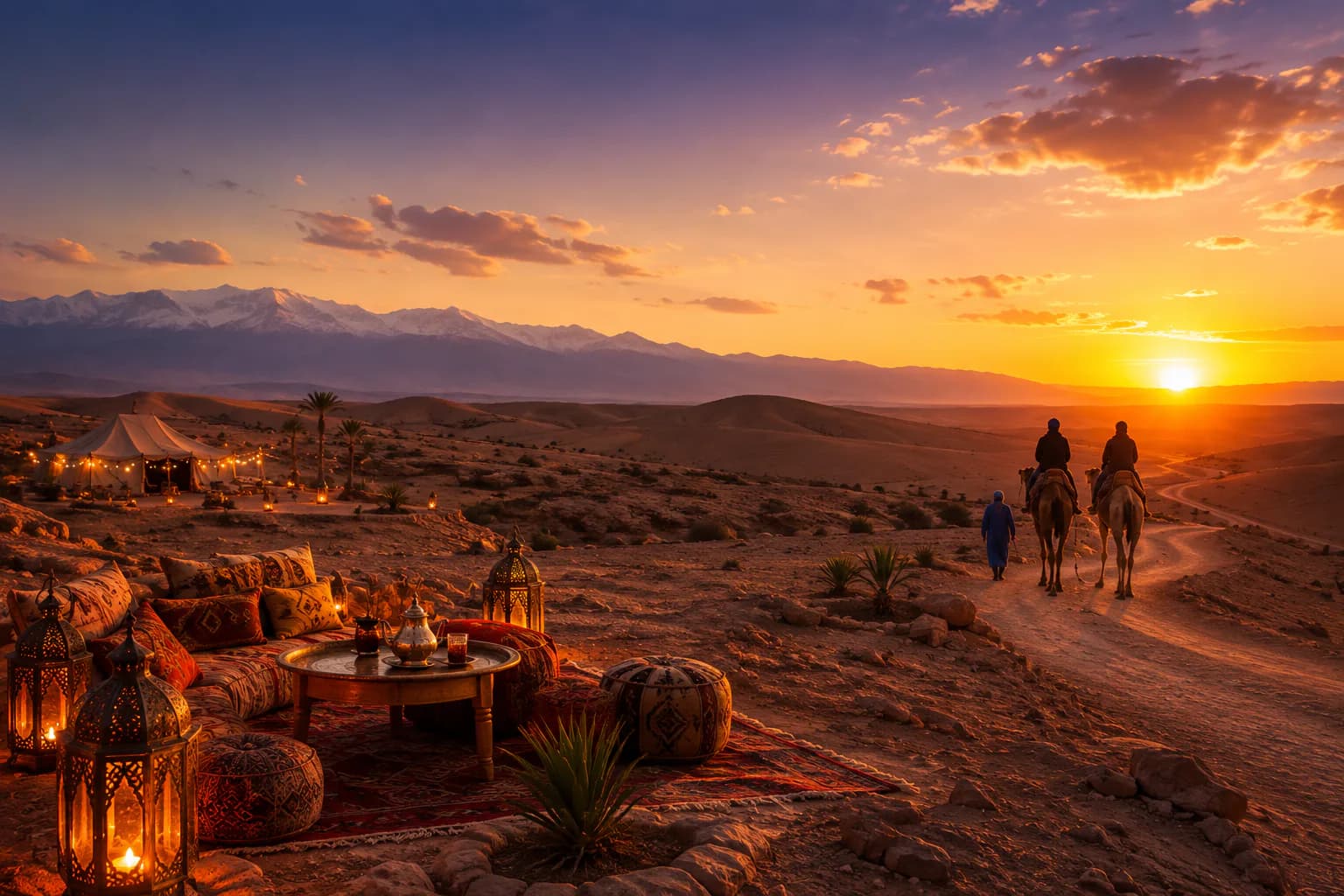
Marrakech is glorious for about three days. Then the medina starts to feel like a very beautiful pinball machine, and you find yourself in Jemaa el-Fnaa at 9pm, dodging a man with a monkey, thinking: I would quite like to see a horizon now, please.
Good news. The best things to do near Marrakech aren't in Marrakech. The bad news, which nobody mentions before you book: "the desert" isn't one place. It's four, they're wildly different, and most disappointed reviews come from people who picked the wrong one.
The four "Marrakech deserts"
Where | From Marrakech | Time needed | Dunes? | From |
|---|---|---|---|---|
Agafay | 40 km, 45 min | An evening | No — rocky plateau | ~€23–35 |
Zagora | 360 km, 6–7 hrs | 2 days | Small, 30–40 m | ~€69 |
Merzouga (Erg Chebbi) | 560 km, 9–10 hrs | 3 days | Yes — up to 150 m | ~€85 |
Erg Chigaga | 450 km + 60 km off-road | 3–4 days | Yes, and empty | 4×4 only |
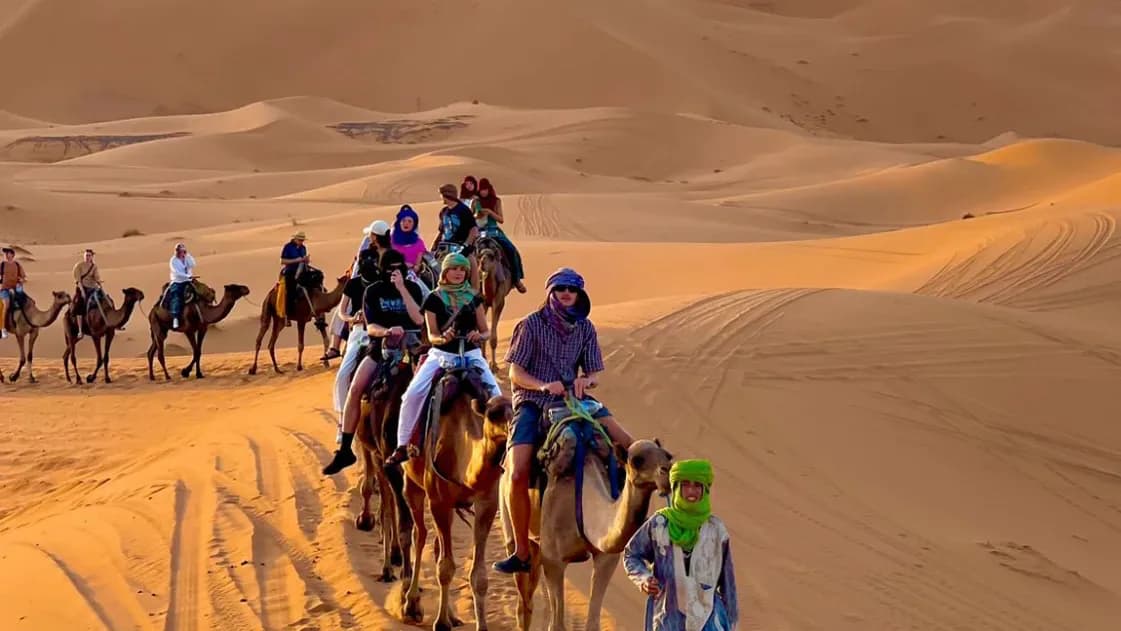
Read the Agafay row twice. It's marketed relentlessly as a desert near Marrakech, but it is categorically not the Sahara, nor a dune desert of any kind — it's a rocky limestone plateau. One local guide describes a French family leaving early because the kids had been promised "playing in the sand." Nobody's lying to you exactly. They're just letting you fill in the blanks.
Agafay: 45 minutes out, and still worth it
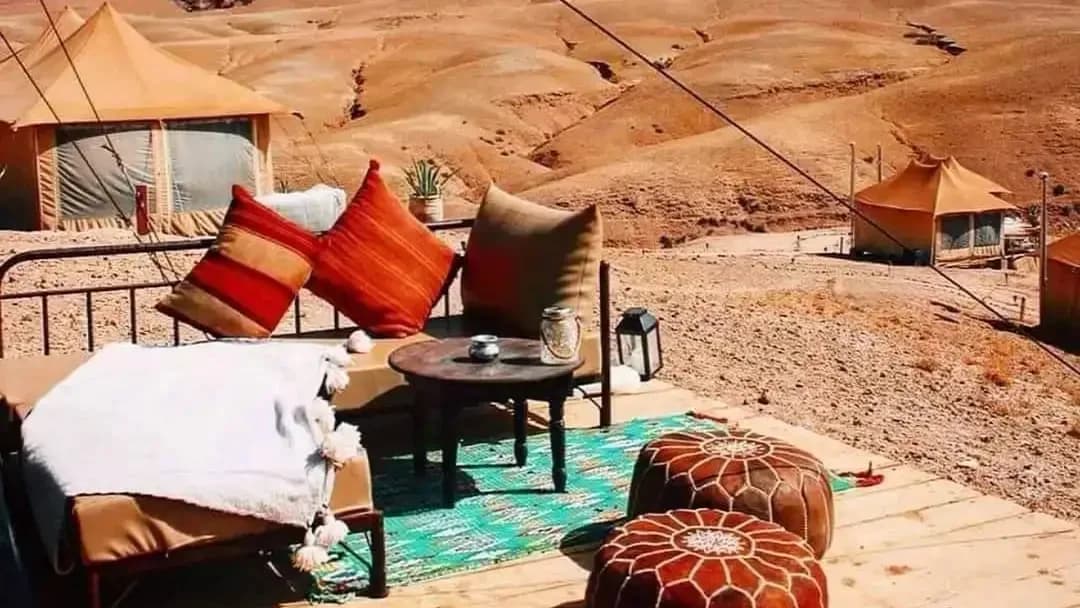
If you have one free evening, Agafay desert tours from Marrakech are the right call. Leave your riad at 4pm, be back by 11, mildly sunburnt and smelling of woodsmoke.
The classic is a sunset camel ride followed by dinner under the stars with live Amazigh music. The better one, for most people, is quad biking across the plateau with the Atlas Mountains sitting there like a painted backdrop — around €35 for an hour, €55 for two, or €100–140 for a two-seater buggy. Sunrise hot air balloon flights are the splurge, from about £170 per person, with tandem paragliding at £100–125.
Agafay is also Morocco's glamping capital, which is either delightful or slightly absurd depending on your feelings about infinity pools in a desert. The two ends of the market are very far apart: shared day trips start around 250 MAD (roughly €23) including transport, a ride, dinner and entertainment, while a night at a high-end camp runs 1,500–3,500 MAD per person.
Two honest caveats. Weekends and the October–April peak get crowded, so go midweek or pick a remote camp. And be suspicious of mega-packages: one reviewer described thirty people queuing for quads, ten minutes on a camel in a line of thirty camels, and dinner for 350. If the photos show a camp the size of a car park, that's what it is.
Verdict: book Agafay as a lovely night out, not as the Sahara. Its sky is also dimmed by Marrakech's city lights. Merzouga's isn't.
Merzouga and Erg Chebbi: the real thing
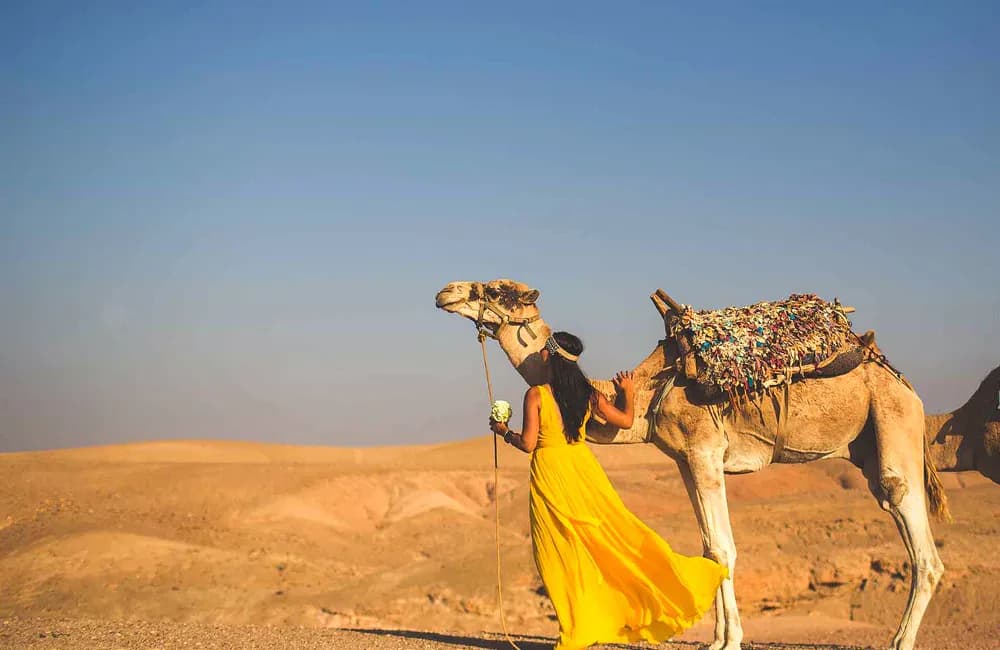
This is the one in your head. Erg Chebbi's dunes reach around 150 metres, the tallest in Morocco, and Merzouga sits roughly 560 km from Marrakech — nine to ten hours by road.
Don't attempt it in two days. Three days is the sweet spot: day one crosses the High Atlas via the Tizi n'Tichka pass, stops at the UNESCO ksar of Aït Ben Haddou, and overnights in the Dades Valley; day two threads Todra Gorge before a sunset camel trek into the dunes; day three is sunrise on a dune and the long road home.
And that road is not a tax you pay for the sand — it's half the trip. Tizi n'Tichka tops out at 2,260 m, the highest paved mountain pass in North Africa; Aït Ben Haddou is where Ridley Scott shot Gladiator's slave-trading scenes and where Game of Thrones built Yunkai — and there is no official entrance fee to the ksar, whatever the person at the gate tells you. Nearby Ouarzazate has Atlas Film Studios at 80 MAD (about €8), and ten kilometres out, the world's largest concentrated solar plant — 510 MW and a field of two million mirrors, glinting away opposite a thousand-year-old mudbrick village. Detour to Telouet Kasbah if your driver will allow it, and to Skoura, where 17th-century Kasbah Amridil is the building printed on the 50 dirham note. Get the note out and hold it up. Cheap thrill, worth it.
Once you're in the sand: sandboarding (free at most camps, and you'll be terrible at it), a 4×4 safari out to the fossil beds and black volcanic hammada, and the sunrise, which is the best free show in Morocco.
The three things most tours skip, and shouldn't:
Khamlia village, where descendants of sub-Saharan Africans play Gnawa music, UNESCO-listed intangible heritage, in a small house for a tip and a glass of mint tea. Thirty minutes. Often the best thirty minutes of the trip.
Dayet Srji, a seasonal salt lake that fills between November and March and pulls in flamingos. Pink flamingos in front of Saharan dunes is a genuinely ridiculous sight.
Rissani souk, forty minutes away, running Tuesdays, Thursdays and Sundays. Dates, spices, actual donkey parking, and nobody trying to sell you a tour.
Zagora and Erg Chigaga, briefly
Zagora gets unfairly slandered. The dunes are modest at 30–40 m, but it's doable in two days, costs less, draws fewer crowds, and the Draa Valley drive is a highlight in itself — plus the "Timbuktu, 52 days" signpost and Tamegroute's green pottery and underground Quranic library.
Erg Chigaga is for people who found Merzouga too busy. Around 40 km of dunes beyond M'Hamid, reached only by a two-hour off-road 4×4 crossing, with far fewer camps and almost nobody else in sight. Less polished, far emptier. That is the entire point.
When to go, and what it costs
October and November are the sweet spot: October highs sit around 30°C with nights at 15°C, and the dunes photograph best in low autumn light with no heat shimmer. March and April are nearly as good. February is quiet and beautiful, with nights cold enough to make a fire feel like a religious experience. Avoid June to August: temperatures regularly hit 45°C and some camps simply close.
Morocco is also having a moment. The country drew a record 7.7 million international visitors in the first five months of 2026, with a target of 30 million a year by 2030, when it co-hosts the World Cup — so expect more operators, and looser use of the word "luxury."
Two red flags from local guides: any operator who won't send a written, itemised list of what's included before departure, and unsolicited "guides" without a government ID badge. Also ask how many hours you'll actually spend at the dunes, not how long the tour is. For reference, a private 3-day tour runs roughly €350–500 depending on group size, and luxury Merzouga camps €80–150 a night — often cheaper than the Agafay equivalent.
On camels: don't book the cheapest ride, look at the animals before you get on, and know that 4×4 transfers to camp are standard everywhere. The sunset is identical either way.
Pack warm layers — yes, for the Sahara, where even in spring nights drop to 5–10°C — a scarf, SPF 50, a headlamp, small notes in dirhams, and a small bag rather than your suitcase. Keep your shoes inside the tent overnight; it keeps scorpions out. Sand will get into your luggage, your camera and your soul. That isn't a metaphor. It's just sand, and it's in everything.
The bottom line
Marrakech is the door, not the room. An evening in Agafay if time is short. Three days to Erg Chebbi if you want the real thing. Chigaga if you want it empty. Book with someone who'll put it in writing, go in October, bring a jumper.
And when you're finally on a dune at dawn with nothing at all on the horizon, leave the phone in your pocket for five minutes. The photo will still be there. The silence won't be, once you're back in Jemaa el-Fnaa dodging that monkey.